
AI Pioneer Yann LeCun Bets $1.03 Billion on "World Models" to Solve AI's Biggest Flaw
Silicon Valley, CA – A seismic shift is underway in the artificial intelligence landscape as Yann LeCun, the renowned "AI Godfather" and Turing Award winner, has launched a new venture, AMI Labs, backed by a staggering $1.03 billion in seed funding. This move signals a significant departure from the current obsession with Large Language Models (LLMs) and a bold bet on a fundamentally different approach to artificial intelligence: "world models."
LeCun, formerly Meta's Chief AI Scientist, left the company in late 2025 amidst growing concerns about the limitations of LLMs and a perceived misalignment with Meta’s AI strategy. He’s now joined forces with Alex LeBrun, previously the CEO of AI-powered healthcare startup Nabla, to build a new kind of AI that moves beyond simply mimicking intelligence to truly understanding the world.
The LLM Problem: "Even a Cat Can Reason Better"
The core issue, according to LeCun, is that current LLMs like ChatGPT are fundamentally flawed. While impressive at generating text and performing specific tasks, they lack genuine reasoning capabilities. LeCun famously quipped that "today's LLMs are even worse than a cat at reasoning." These models, he explains, operate by predicting the next word in a sequence based on massive datasets, essentially "imitating" intelligence rather than possessing it.
This reliance on statistical prediction leads to a critical problem: hallucinations. LLMs can confidently generate incorrect or nonsensical information, a significant barrier to their reliable use in critical applications.
Enter "World Models": AI That Understands Physics and Causality
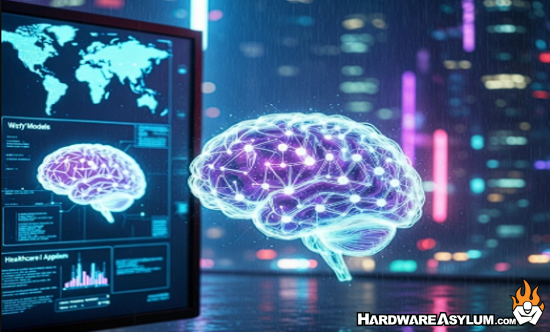
AMI Labs’ solution is to build AI systems based on "world models." Drawing inspiration from the human brain, these models aim to create a comprehensive understanding of the physical world, including its rules, relationships, and causal connections. Instead of solely relying on text data, AMI Labs will train their AI using visual and sensor data, mirroring how infants learn about the world through observation.
Think of it this way: a child understands that if you drop a ball, it will fall due to gravity. An LLM, lacking this fundamental understanding, might generate a response suggesting the ball floats. AMI Labs aims to equip AI with this kind of intuitive, physics-based understanding.
A Stellar Team and a Who's Who of Investors
The ambition of AMI Labs has attracted significant attention and investment. The $1.03 billion seed round, the largest ever for a European startup, includes backing from prominent investors like Cathay Innovation, Greycroft, HV Capital, Jeff Bezos’s family office, and industry giants Nvidia, Samsung Electronics, Toyota Ventures, and Temasek. The investor roster also boasts tech luminaries like Eric Schmidt (former Google CEO) and Mark Cuban.
LeCun has assembled a world-class team to execute this vision. Alongside LeBrun, the company includes Saining Xie (formerly of Meta and Google DeepMind), Pascale Fung, and Michael Rabbat, all leading experts in AI research. Laurent Solly, former Meta Europe VP, joins as COO.
First Focus: Revolutionizing Healthcare AI
AMI Labs is initially focusing its efforts on the healthcare sector. The company has already established a strategic partnership with Nabla, LeBrun’s previous venture, which provides AI-powered tools for physicians. Healthcare data is inherently noisy and continuous (think vital signs and medical imaging), making it a challenging environment for LLMs. AMI Labs believes that their world model approach can unlock significant advancements in medical diagnosis, treatment planning, and patient care, moving beyond simple data documentation to true "agentic AI" that actively assists medical professionals.
A Bold Vision for the Future of AI
AMI Labs’ launch represents a significant challenge to the current LLM-dominated AI landscape. By focusing on building AI systems that genuinely understand the world, LeCun and his team are aiming to create a new generation of AI that is more reliable, trustworthy, and capable of solving real-world problems. The success of this ambitious venture could reshape the future of artificial intelligence and its impact on society.