
After careful consideration I have decided to transfer all hardware review activities to a new domain. I purchased Hardwareasylum.com in 2012 and have been working hard to build a new and improved Ninjalane on that domain. If you are reading this you have reached one of the archived articles, news, projects and/or reviews that were left behind during the site migration.
Please update your bookmarks and be sure to visit the new and improved Ninjalane at Hardwareasylum.com
Foxconn Winfast NFPIK8AA Motherboard Review
Author: Dennis Garcia
Published: Monday, April 03, 2006

Benchmarks - Overclocked
Overclocking
Overclocking is one arena were we try our hand at getting the highest performance from what we are given. Many sites out there try their best to overclock their systems to some insane HTT levels but performance numbers don't justify the additional stress. On the 940pin platform you have to take a different approach to overclocking. The inherent nature of registered memory prevents aggressive overclocks since the registers are expecting data at a certain speed and running the memory slower than this speed appears to be the key.
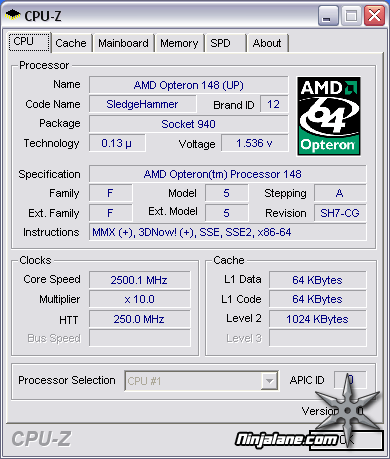
From an overclocking standpoint the Foxconn Winfast NFPIK8AA is clearly not designed for it but the engineers did expose several overclocking controls. After some serious work and a fried motherboard later it would seem that a 300Mhz overclock @ 250HTT was pretty much the limit.
Keep in mind your mileage can and most likely will vary from what we are reporting. The idea here is to give you an idea as to what you can expect given our test system.
From an overclocking standpoint the Foxconn Winfast NFPIK8AA is clearly not designed for it but the engineers did expose several overclocking controls. After some serious work and a fried motherboard later it would seem that a 300Mhz overclock @ 250HTT was pretty much the limit.
Keep in mind your mileage can and most likely will vary from what we are reporting. The idea here is to give you an idea as to what you can expect given our test system.
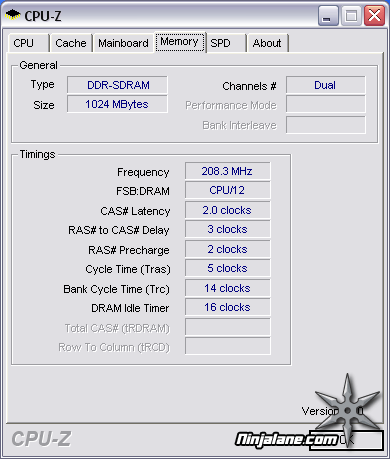
CPU-Z 250HTT @ 2.5Ghz
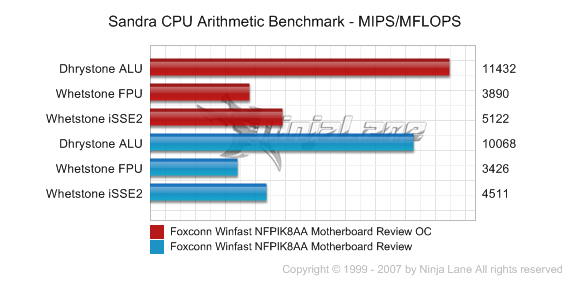
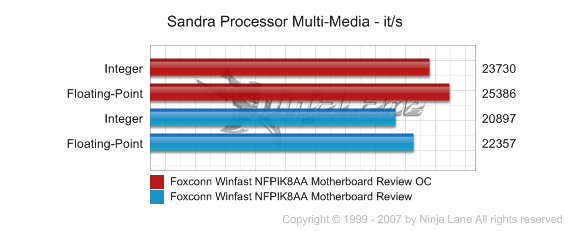
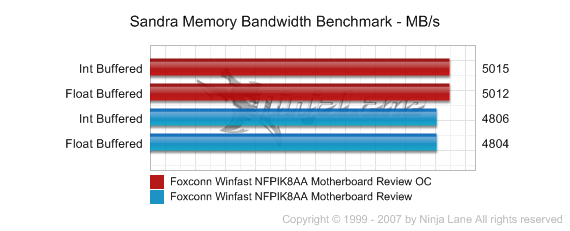
SiSoft Sandra Various Overcloc
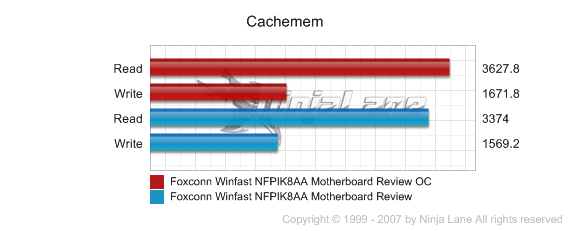
Cachemem
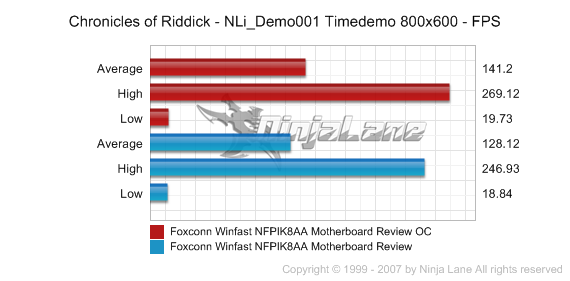
Chronicles of Riddick
Overclocking Conclusion
The primary purpose of our overclocking adventure was to see if memory performance could be increased. Despite the additional HTT bandwidth and extra 300Mhz on the processor clock the memory performance remained pretty much the same. On the positive side a good 20FPS gain on our Riddick game did help smooth out the rough parts.
The only concern about overclocking the NFPIK8AA was that it had to be done in steps. For instance when raising the HTT we needed to give the processor a slight bump in voltage but couldn't increase the HTT clock until after we rebooted with the new voltage setting otherwise the POST would fail. We also discovered that on a failed POST if the reset button was pressed the system would often post fine with the adjusted values. This seems to be either a timing issue between the Pro chipsets or the result of weak BIOS programming.